
Review · CANADA
Toronto: Hollywood North Experience Film & TV Tour
Toronto is often dressed up as New York, Chicago, Washington, and even fictional cities on screen. This 2.5-hour walking tour lets you see the disguise up close, matching clips from productions such as Suits, The Boys, Suicide Squad, The Handmaid’s Tale, Degrassi, Rookie Blue, American Psycho, and Star Trek with the real streets and buildings around you.
I like two things especially: you watch scenes on a tablet while standing at the filming site, and your guide works in the Canadian film business. Guides such as Jacqueline, Michael, Winnie, and others bring useful production stories that a standard city walk cannot provide. The main drawback is the pace and distance: you cover about 3.5 kilometres outdoors, rain or snow, with limited appeal if walking is difficult or you do not recognize many of the shows.
Key points before you book
- See Toronto double as other cities: Learn how familiar streets become New York, Chicago, or fictional locations on screen.
- Watch clips at the exact places: The tablet presentations help you spot details that are easy to miss when you simply walk past.
- Meet at David Pecaut Square: Look for the guide carrying a blue umbrella across from the Royal Alexandra Theatre.
- Hear from a film professional: Your guide may be an actor, director, or producer with first-hand industry experience.
- Cover major downtown sights: The route includes Union Station, the Financial District, Old City Hall, Nathan Phillips Square, the CN Tower, Eaton Centre, and Yonge-Dundas Square.
- Plan for outdoor walking: The tour lasts 150 minutes and runs rain or snow, so shoes and clothing matter.
Why Toronto makes such a good film set
Toronto has the scale of a major North American city, but its downtown streets can be adapted to play many different places. That is the central idea behind this tour. You are not just hunting for famous buildings. You are learning how camera angles, street design, architecture, and a few production tricks can turn one city into another.
A Toronto street may look ordinary in person, then become a courtroom district, corporate headquarters, police station, or sinister urban corner on screen. The fun comes from comparing the real location with the finished scene. A clip gives you the missing pieces: where the actors stood, which direction the camera faced, and how a familiar building was made to serve a different story.
The tour also adds a useful city walk. You pass through the Financial District, the theatre district, civic squares, and shopping areas. That makes this a good first activity in Toronto if you want film stories with a basic introduction to downtown.
The strongest appeal is not simply seeing places connected to famous productions. It is learning to look at the city like a location scout. After the tour, you may notice how a doorway, stone façade, alley, or broad square can suggest a different city once the camera arrives.
More Hollywood and Celebrity Home Tours in the world:
- Los Angeles: Warner Bros. Studio Tour Hollywood
★ 4.6 · 7,191 reviews - Full-Day Iconic Sights of LA, Hollywood, Beverly Hills, Beaches and More
★ 5.0 · 6,147 reviews - Warner Bros. Studio Tour Hollywood
★ 4.5 · 5,246 reviews
Starting at David Pecaut Square
The tour begins at David Pecaut Square, in the courtyard across from the Royal Alexandra Theatre on King Street. This is a sensible meeting point in the theatre district, but allow time to find the square rather than arriving at the last second.
Look for the guide with a blue umbrella. That detail matters in a busy downtown area, especially if several groups are gathering nearby. Arrive on time. Late arrivals may be treated as no-shows, and the walking group cannot easily wait once the route begins.
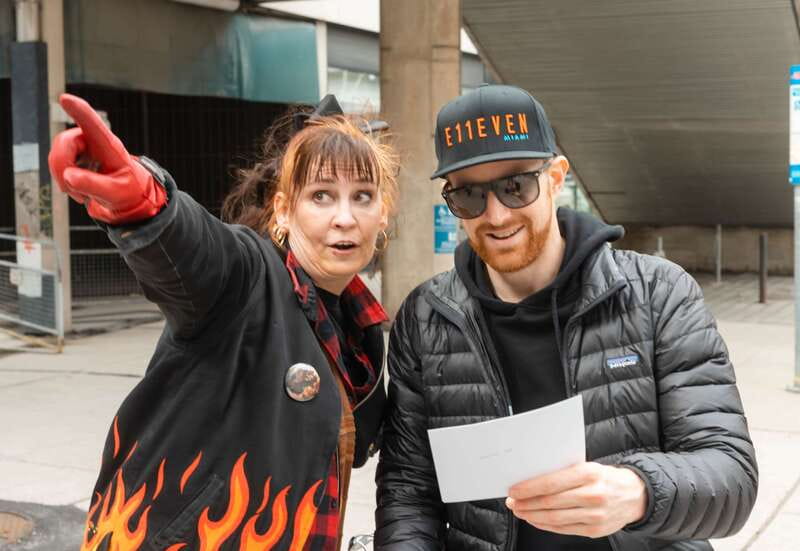
From the start, the tour has a local feel. Your guide is a Toronto film-industry professional, such as an actor, director, or producer. Guides named in past outings include Jacqueline, Michael, Winnie, and others. The exact guide will vary, but the format gives you a chance to ask practical questions about sets, actors, filming schedules, and the work behind a finished scene.
Union Station and the Financial District
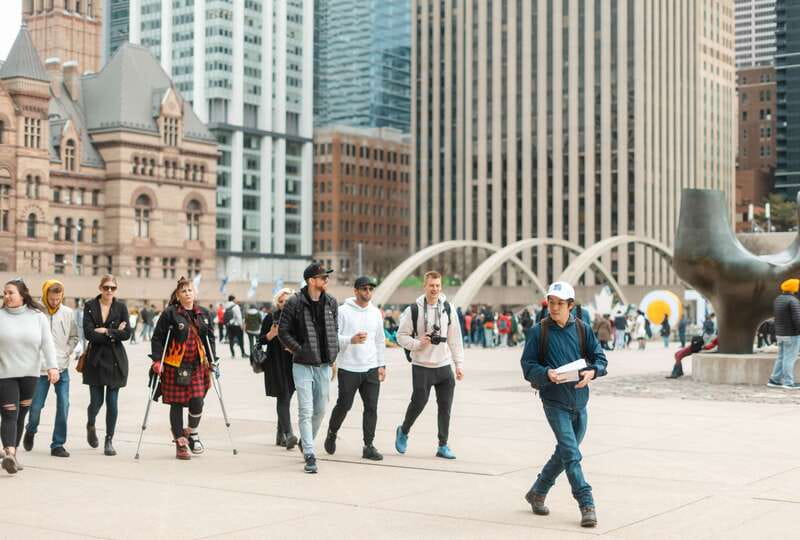
Union Station is one of the early major stops. You have time for a photo, a guided look, and a short walk through the area. The station is useful here because it works both as an important Toronto landmark and as a ready-made cinematic setting.
Pay attention to the scale of the space and the formal architecture. These qualities can make Toronto look like a much larger American city on film. Your guide explains how productions use public buildings and nearby streets, and the tablet clips help you connect the real setting with its screen version.
The Financial District follows through a series of stops, including several locations kept as surprises. That approach adds some fun, particularly if you enjoy recognizing a place a few seconds before the guide reveals its film connection. At each stop, you can expect a short explanation, a chance to look around, and a clip or story that shows how the location was used.
These secret stops are also where the film focus becomes more personal. You are not only told the title of a production. You hear about the moving parts of a shoot, such as how a scene is framed and how a location can be adjusted to suit the story. The amount of detail depends on your guide and the group, but the working-film background is a major reason to choose this tour instead of a general downtown walk.
The tablet clips make the locations click
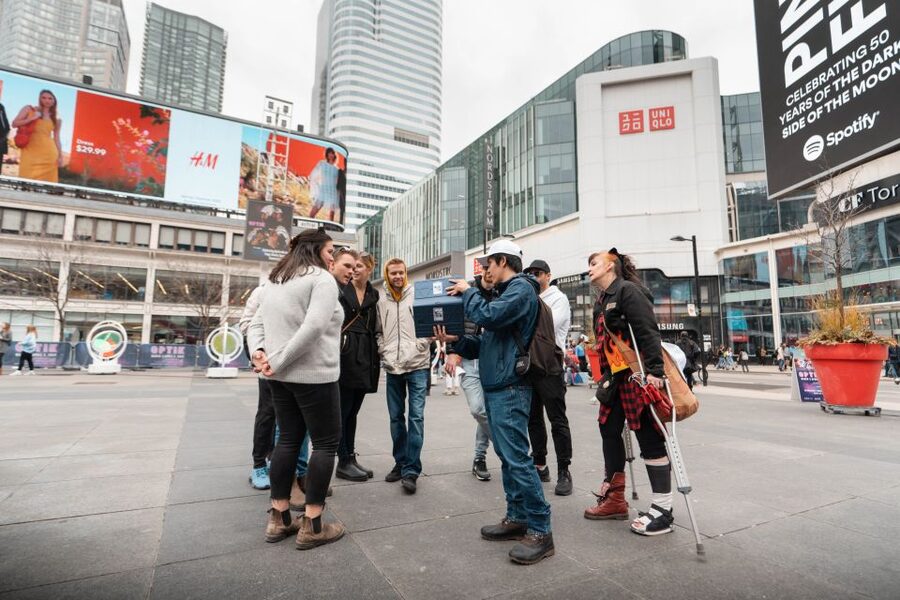
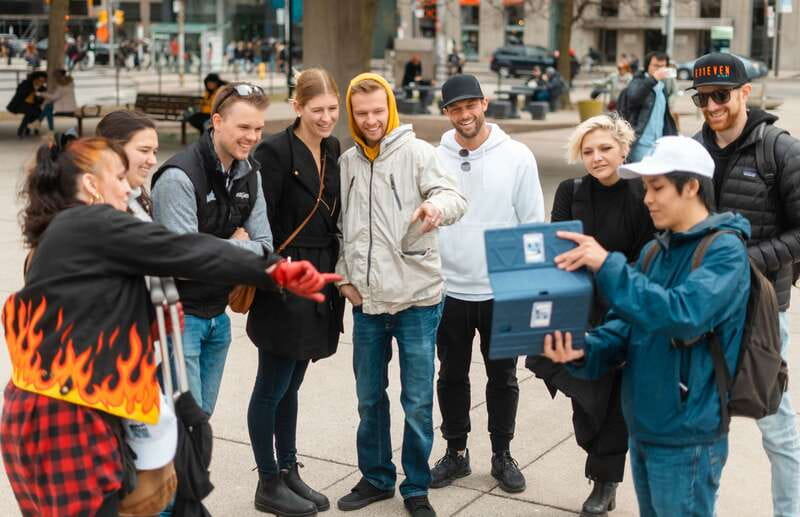
The clips are the tour’s most useful feature. A building can be hard to recognize from a brief description, especially if the finished scene uses night lighting, costumes, visual effects, or a different camera angle.
Seeing the footage at the location solves that problem. You can compare the doorway, street line, windows, or square in front of you with the image on the tablet. This turns the walk into a small piece of detective work.
I also like that the clips give the tour a clear rhythm. You walk, stop, watch, and then look at the site with fresh eyes. The tour is not simply a lecture about productions you may or may not know. It gives you something visual to examine.
Some clips depict violence and are rated PG-13. That is worth noting for families. The tour is open to people of all ages in general, but parents should consider the content before booking for younger children.
More Film Location Tours in the world:
- From London: Harry Potter Warner Bros Studio Tour
★ 4.7 · 26,588 reviews - Magical London: Harry Potter Guided Walking Tour
★ 4.7 · 22,044 reviews - London: Warner Bros. Studio Harry Potter Tour & Branded Bus
★ 4.7 · 19,194 reviews - Edinburgh: Harry Potter Magical Guided Walking Tour
★ 4.8 · 11,944 reviews
A local café and the theatre district
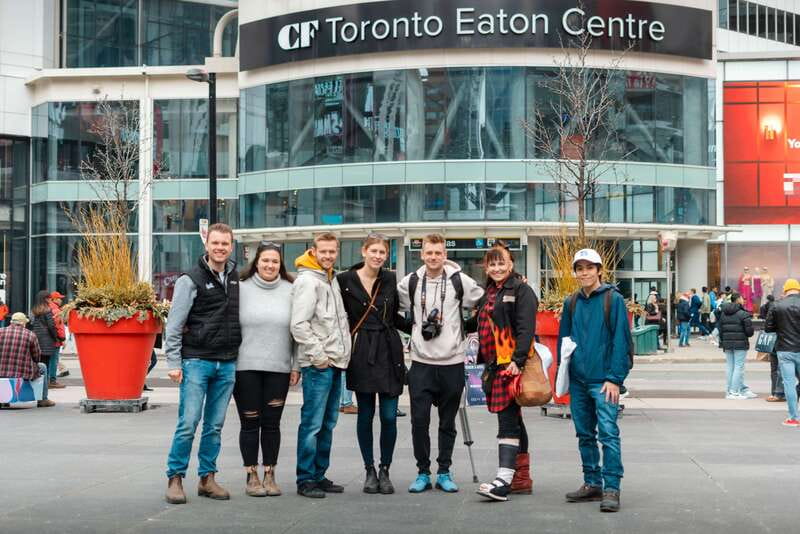
The route includes a local café as a brief pass-by stop, then continues toward the Elgin and Winter Garden Theatres. The theatres add a different side of Toronto’s entertainment story. Here, the focus is not only on screen productions but also on the city’s long connection with live performance.
You stop for photos and pass by the theatre buildings rather than attending a performance. That distinction matters. This is a walking tour, not a theatre visit, so you should not expect entry or a show ticket.
The area also helps you understand the mix of Toronto’s downtown. Film crews use office towers, civic buildings, train stations, theatres, shopping streets, and public squares because the city puts many different settings within a manageable distance. The route makes that variety clear without sending you across town by bus or subway.
Old City Hall, City Hall, and Nathan Phillips Square
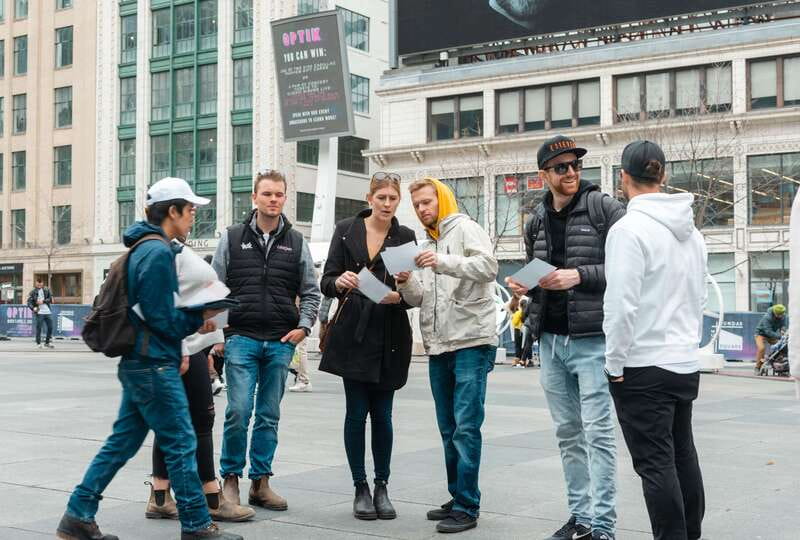
Toronto Old City Hall is one of the route’s most interesting architectural stops. You have time for photos, sightseeing, and a guided explanation. Its older civic design gives the tour a useful contrast with Toronto’s modern towers and glass offices.
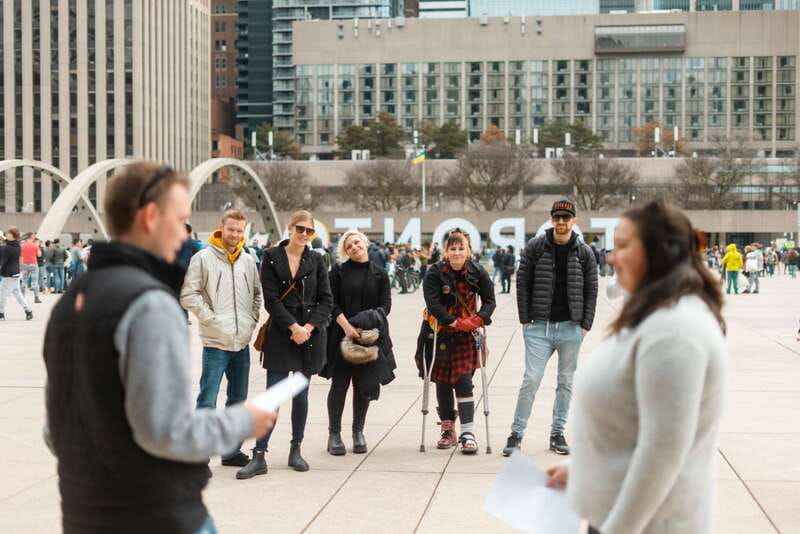
Toronto City Hall and Nathan Phillips Square then show another face of the city. The newer City Hall is immediately recognizable, and the square provides room to pause, take photos, and watch the city around you. The scheduled break at Nathan Phillips Square lasts about 20 minutes, making it one of the more relaxed parts of the route.
This is also a good place to see how a civic space can work on camera. Wide open areas, strong architectural shapes, and clear sightlines are valuable to film crews. Your guide can show you what the camera sees and what remains outside the frame.
The central downtown stops give the experience more value than a narrow movie-location hunt. Even if you have not seen every production named on the route, you still get landmarks, architecture, and a basic sense of Toronto’s civic center.
The CN Tower view from street level
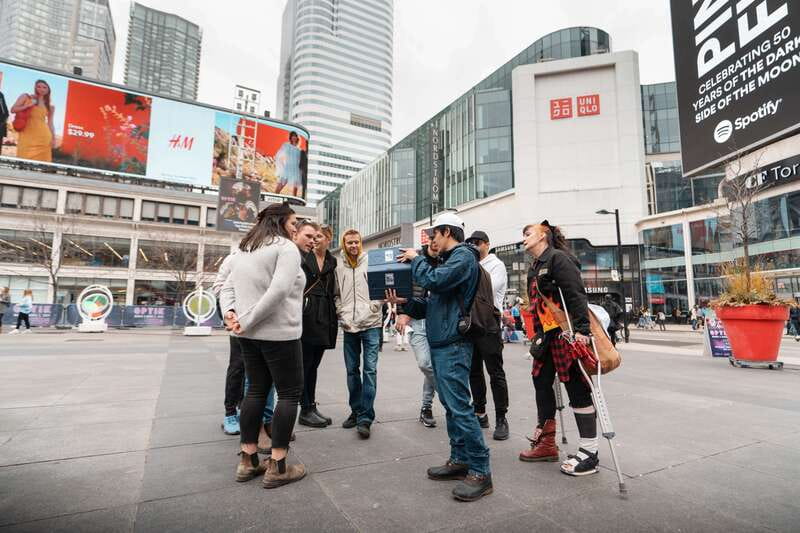
The route includes a short photo stop outside the CN Tower. At about five minutes, this is not a tower visit, and your ticket does not include entry to the observation levels.
Still, the stop gives you a familiar Toronto image and a chance to place the earlier downtown locations within the city. The contrast between the tower and the older civic buildings is part of what makes Toronto useful on screen. You see modern engineering, historic architecture, office towers, and public squares packed into one walk.
Keep your expectations realistic here. If you want to go up the CN Tower, plan that separately. This tour uses it as a landmark and filming reference, not as a full attraction visit.
Eaton Centre and Yonge-Dundas Square
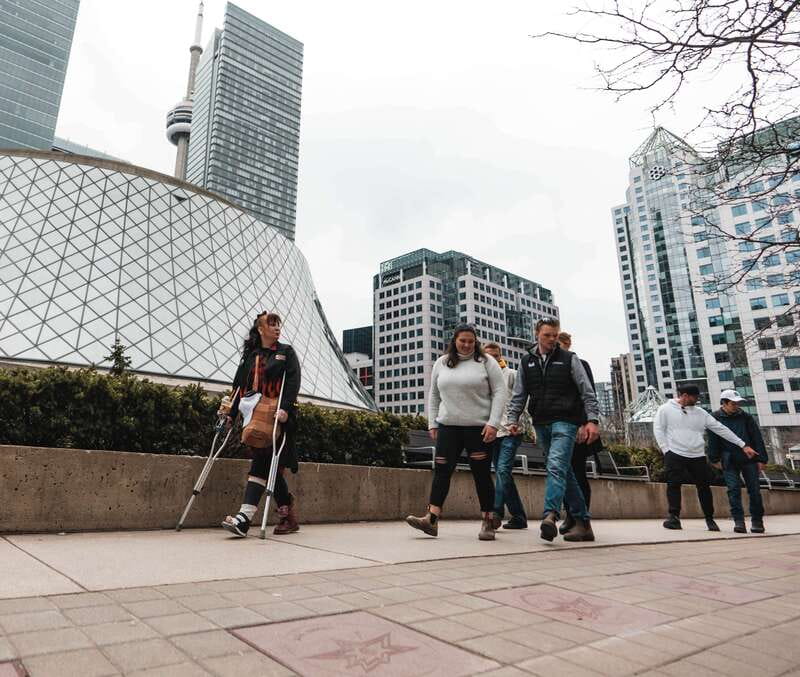
The Toronto Eaton Centre is the final major indoor stop before the tour ends at Yonge-Dundas Square. You pass through the shopping center with guided sightseeing, then continue to the square.
The Eaton Centre can be useful on a warm or wet day because parts of the route move through indoor buildings. One past outing on a hot day benefited from these air-conditioned sections, although you should still plan for plenty of outdoor walking.
Yonge-Dundas Square makes a lively finish because it is a very different setting from the quiet civic spaces and formal buildings earlier in the route. It is also a practical ending point, with the rest of downtown within easy reach. Since the tour finishes here, you can continue sightseeing, shop at the Eaton Centre, or make your own way to another Toronto attraction.
The finish is not at the starting point, so plan your afternoon around a one-way route. No transportation is included, and the tour itself is entirely on foot.
What the 150 minutes feel like
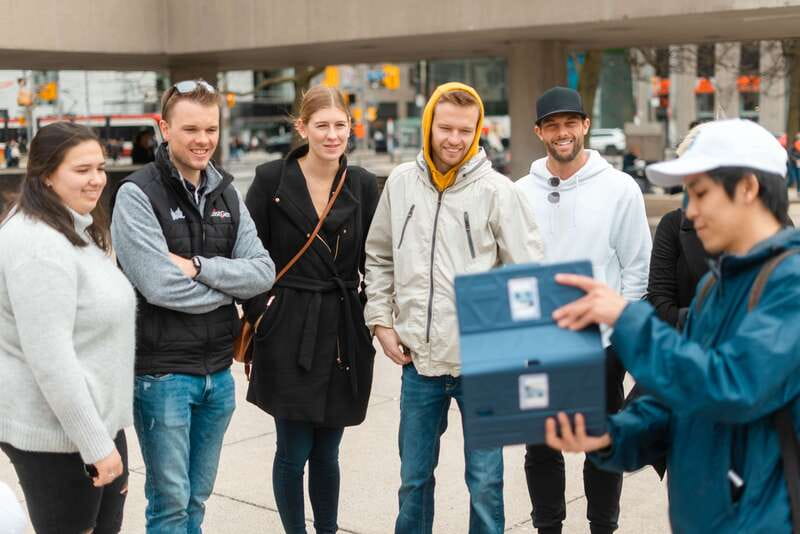
Two and a half hours is a good length for this subject. It gives the guide enough time to show several productions and city landmarks without turning the day into an exhausting half-day outing.
You will walk around 3.5 kilometres, or roughly two miles. That distance is manageable for most people who are comfortable walking through downtown, but the frequent stops do not remove the need for steady movement. You may stand outside while listening, cross busy streets, and keep moving between locations.
The tour runs rain or snow. Bring weather-ready clothing and comfortable shoes. A sunny day will make the photos easier, but bad weather can also add a little atmosphere to a movie-location walk. The important point is that you should not book this expecting an indoor activity.
The group size can vary. A small group may give you more time for questions and make the tour feel conversational. Larger groups may have less room for individual discussion, though the tablet clips and fixed stops still give the route structure.
Is the $35 price good value?
At $35 per person, this is fairly priced for a 150-minute guided walk with a specialist guide. You are paying for more than a list of addresses. The price includes a local film professional, the clips, the downtown sightseeing, and the interpretation that links real streets to finished productions.
The value is strongest if you have seen some of the featured shows or films. Recognizing Suits, The Boys, Suicide Squad, The Handmaid’s Tale, Degrassi, Rookie Blue, American Psycho, or Star Trek gives you more moments of recognition. The tour can still work if you know only a few titles, since the architecture and city stories fill in the gaps.
It is less compelling if you want to enter film studios, meet celebrities, or visit a large museum display. This is an outdoor location walk. You see where scenes were made, but you do not tour active soundstages or receive food and drinks.
Food and transportation are not included. The route passes a local café, but that is part of the walk rather than a promised meal stop. Bring water and arrange your own snacks if needed.
Who will enjoy this tour most?
I would recommend it to film fans, first-time Toronto visitors, local residents curious about the city, architecture admirers, and anyone who enjoys learning how ordinary places are transformed for the screen.
It is especially good for people who like practical behind-the-scenes information. A working actor or other film professional can explain the production process in a way that a standard sightseeing guide may not. The personal stories and industry anecdotes also help keep the walk lively.
Families can consider it, but check the PG-13 clips first. People with mobility impairments should not book this activity, since it requires walking 3.5 kilometres over 2.5 hours. You also need to be ready for rain or snow.
Bring a passport or ID card, as requested in the tour information. Wear good walking shoes, check the forecast, and arrive early enough to find David Pecaut Square and the blue umbrella.
Should you book the Hollywood North Experience?
Book it if you want Toronto sightseeing with a clear film angle, especially if you enjoy seeing clips matched to real streets. The local-industry guide, surprise stops, and mix of movie locations with major landmarks give you more substance than a simple photo walk.
Skip it if you need a fully indoor activity, have trouble walking several kilometres, or mainly want to tour the CN Tower or enter theatres. Those attractions are only viewed from the route.
For most film fans and curious first-time visitors, $35 is a sensible spend. You finish with a better eye for Toronto’s buildings, a handful of screen-location discoveries, and a clearer idea of how this city becomes somewhere else when the cameras roll.
FAQ
How long is the Toronto film and TV tour?
The tour lasts 150 minutes, or 2.5 hours.
How far do you walk?
You walk about 3.5 kilometres, or two miles, over the course of the tour.
Where does the tour start?
It starts at David Pecaut Square in downtown Toronto, in the courtyard across from the Royal Alexandra Theatre on King Street.
How do I find the guide?
Look for the guide holding a blue umbrella at the scheduled starting time.
Where does the tour finish?
The tour finishes at Yonge-Dundas Square.
Is transportation included?
No. Transportation is not included, and the tour itself is a walking experience.
Does the tour run in bad weather?
Yes. The tour operates in rain, snow, or sunshine.
What language is the tour in?
The live guided tour is conducted in English.
Just added in the world
- Hobbiton Movie Set Guided Day Tour with Lunch from Auckland★ 5.0 · 3 reviews
- Private Hobbiton Movie Set & Waitomo Caves in a Day from Auckland★ 5.0 · 2 reviews
- Private Journey to Middle-earth: Hobbiton Movie Set – Ex Auckland★ 5.0 · 7 reviews
- Auckland to Rotorua via Hobbiton Small Group Tour (One Way)★ 5.0 · 72 reviews
- From Auckland:Hobbiton Movie Set & Waitomo Caves Small Group Tour★ 5.0 · 23 reviews
- Auckland to Rotorua, Hobbiton and Waitomo 1 Way Small Group Tour★ 5.0 · 6 reviews
- Auckland to Waitomo Caves and Hobbiton Movie Set Private Tour★ 5.0 · 12 reviews
- Private Hobbiton Movie Set and Rotorua Day Trip from Auckland★ 5.0 · 10 reviews
Hollywood and Celebrity Home Tours, compared.
Full-Day Iconic Sights of LA, Hollywood, Beverly Hills, Beaches and More
Read our review →
Hollywood, Beverly Hills & Celebrity Homes Tour by Open Air Bus
Read our review →
Hollywood & Celebrity Homes Open-Air Bus Tour
Read our review →
Los Angeles and Hollywood Small Group Day Tour from Las Vegas
Read our review →
Celebrity Homes and Hollywood Open-Air Bus Tour
Read our review →This one also appears on